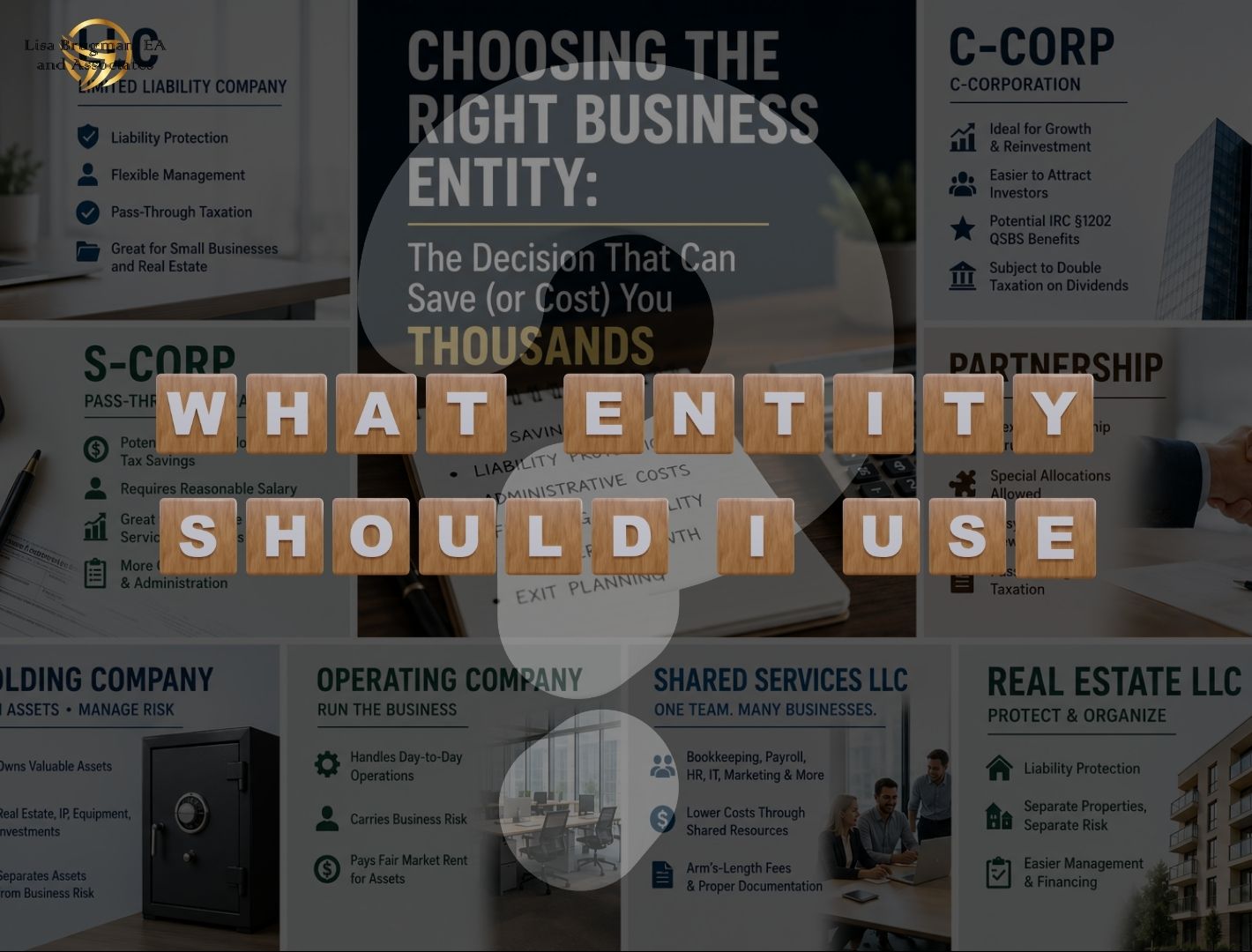
What entity should I use?
Choosing the Right Business Entity: The Decision That Can Save (or Cost) You Thousands
One of the first questions I hear from business owners and real estate investors is:
"What entity should I use?"
The answer is almost never "always form an LLC" or "everyone should elect S-Corp status."
The right answer depends on your income today, your goals tomorrow, your liability risk, and your exit strategy years from now.
I've seen people spend thousands fixing entity mistakes that could have been avoided with a little planning. So let's walk through the big decisions.
LLC vs. S-Corp
This is probably the most misunderstood comparison.
Here's the secret:
An LLC is a legal entity. An S-Corp is a tax election.
An LLC protects your personal assets from many business liabilities (assuming you operate it correctly). An S-Corp changes how the IRS taxes your business.
An LLC may be best if:
You're just starting out.
Your profits are modest.
You want simple administration.
You own rental real estate.
An S-Corp may make sense when:
Your business consistently earns enough profit to pay yourself a reasonable salary and still have additional profit left over.
You want to reduce self-employment tax.
You have a service business with growing income.
The tax savings can be significant—but only if the numbers justify the extra payroll, bookkeeping, and compliance costs.
LLC vs. C-Corp
Most small businesses do not need a C-Corporation.
However, there are situations where a C-Corp becomes a powerful planning tool.
A C-Corp may be worth considering if you:
Plan to reinvest profits.
Need outside investors.
Want extensive executive fringe benefits.
Are building a company you intend to scale or sell.
May qualify for the potential benefits of IRC §1202 Qualified Small Business Stock.
The downside?
Potential double taxation if profits are distributed as dividends.
For many small businesses, that outweighs the benefits.
Partnership vs. S-Corp
Both are pass-through entities, but they operate very differently.
Partnerships are incredibly flexible.
They allow:
Special allocations
Complex ownership structures
Different classes of investors
Easier admission of new partners
S-Corps are much more restrictive.
They require:
One class of stock
Eligible shareholders
Pro-rata ownership allocations
If you're bringing in investors or building a real estate investment business with multiple owners, a partnership is often the better choice.
If you're operating a profitable service business with one or two owners, an S-Corp may reduce employment taxes.
When Should You Elect S-Corp Status?
This is the question everyone wants answered.
There isn't a magic income number.
Instead, I look at several factors:
Net business profit
Reasonable compensation
Payroll costs
State taxes
Future growth
Retirement planning
Administrative costs
Sometimes an S-Corp saves thousands.
Sometimes it actually increases taxes.
That's why every situation deserves its own analysis.
Should My Rental Property Be in an LLC?
For many investors, the answer is yes—but not because of taxes.
A single-member LLC usually does not change your federal income taxes.
Instead, it provides:
Liability protection
Separation between properties
Easier management
Better organization
Your lender, insurance coverage, state law, financing plans, and estate planning goals all matter.
One size definitely does not fit all.
How Many LLCs Should I Have?
This is another common misconception.
Some investors create an LLC for every property.
Others place twenty properties into one LLC.
Neither approach is automatically correct.
Consider:
Property value
Equity
Liability exposure
Insurance coverage
State filing costs
Administrative burden
Financing requirements
Sometimes one LLC makes sense.
Sometimes separate entities dramatically reduce risk.
The answer depends on what you're trying to protect.
Should My Business Own the Building?
Usually, I recommend separating the operating business from the real estate.
Why?
If your operating business is sued, you generally don't want the business also owning your most valuable asset.
A common structure is:
Real estate owned by one entity.
Operating business owned by another.
The operating company pays fair market rent.
This separation can provide better liability protection and greater flexibility if you later sell either the business or the property.
Holding Company vs. Operating Company
As businesses grow, so do risks.
Many larger businesses separate ownership into:
A holding company that owns valuable assets.
An operating company that runs the day-to-day business.
The operating company carries most of the business risk.
The holding company owns assets such as:
Intellectual property
Equipment
Real estate
Ownership interests
This structure won't fit every business, but it often becomes valuable as companies become more profitable.
Shared Services LLC
If you own multiple businesses, you may notice everyone needs bookkeeping, payroll, HR, marketing, administrative support, and technology.
Instead of duplicating those costs, many owners create a shared services company that provides these services to each operating business for an arm's-length fee.
When structured correctly, this can improve efficiency, simplify management, and create clearer financial reporting. It must be properly documented, with reasonable charges that reflect the services provided.
Asset Protection and Planning for the Future
Choosing an entity isn't just about today's taxes.
It's about protecting what you're building.
Think about:
Lawsuit exposure
Insurance coverage
Estate planning
Bringing in partners
Selling the business
Transferring assets to family
Raising capital
Multi-state operations
The best entity today may not be the best entity five years from now.
That's okay.
Good tax planning evolves as your business grows.
The Bottom Line
The biggest mistake I see isn't choosing the "wrong" entity—it's choosing one because someone on social media said it was the best.
Entity selection should balance:
Tax savings
Asset protection
Administrative costs
Financing flexibility
Long-term growth
Exit planning
The structure that works for your neighbor may be exactly the wrong one for you.
Not sure which entity you need? Book a call with Lisa Brugman, EA & Associates.
Take the time to build the right foundation now. Future you—and your wallet—will be glad you did.


