
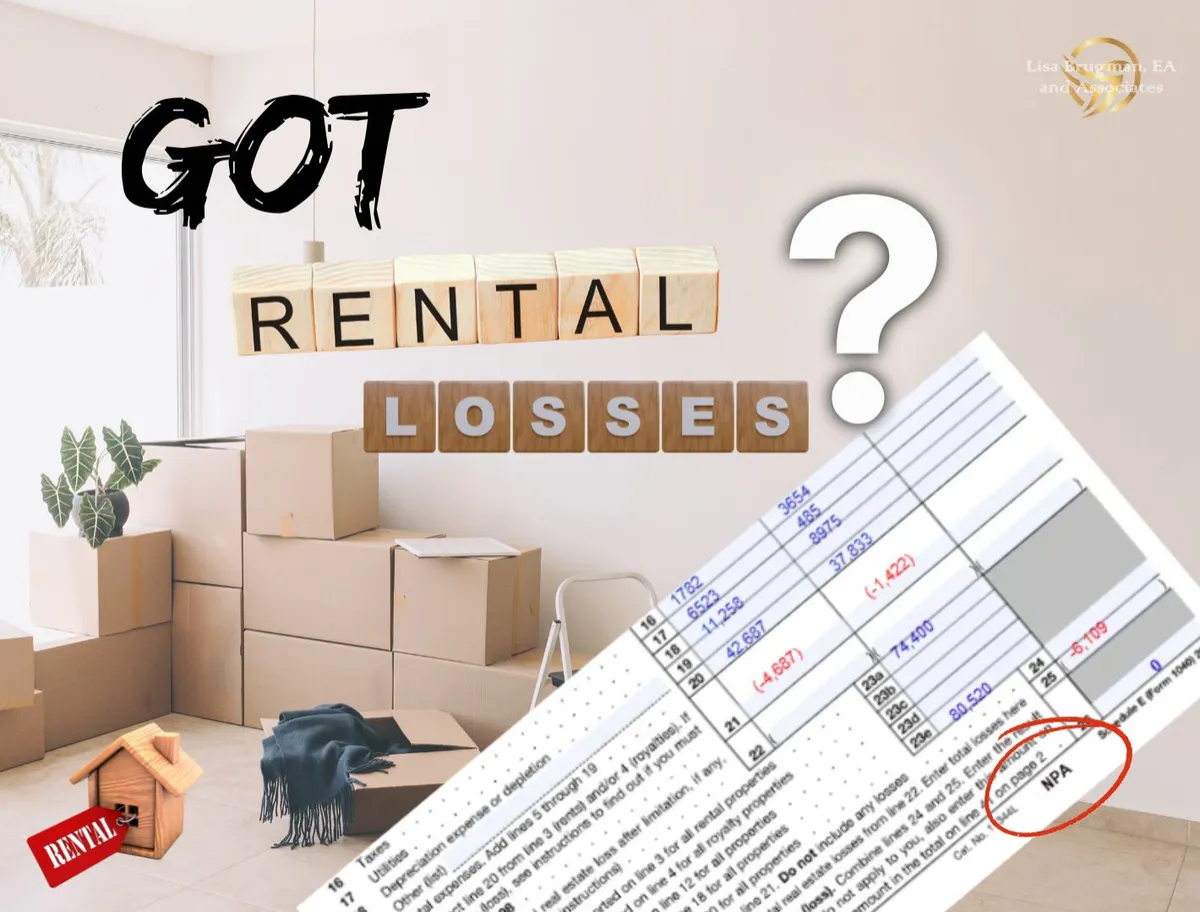
Got Rental Losses?
🏡 Can You Deduct Rental Property Losses?
Owning rental real estate can be a great way to build wealth.
You may get:
🏡 Monthly cash flow
📈 Long-term appreciation
💰 Equity growth
🧾 Depreciation and other tax deductions
But here's where many real estate investors get surprised:
A rental property can lose money on your tax return without giving you an immediate tax deduction.
You might have a $20,000 rental loss sitting right there on Schedule E—and still be unable to use all of it against your W-2 income. See the NPA at the bottom of page 1 of the Schedule E.
Why?
Welcome to the wonderful world of the passive activity loss rules. 😬
Let's break down when rental losses may be deductible, when they're suspended, and what can potentially unlock them.
💸 Why Can't I Just Deduct My Rental Loss?
For federal income tax purposes, rental activities are generally considered passive activities.
That's true even when being a landlord doesn't feel remotely passive.
You could be:
🔧 Coordinating repairs
📞 Talking with tenants
🏡 Reviewing applications
💵 Collecting rent
🧾 Paying bills
🚽 Dealing with a broken toilet at 10 p.m.
…and the activity can still be considered passive under the tax rules.
Generally, passive losses can offset passive income, but they can't automatically offset nonpassive income such as wages or income from a business in which you materially participate. IRS
But rental real estate has an important exception.
💰 The $25,000 Special Rental Real Estate Allowance
If you actively participate in rental real estate, you may be able to deduct up to:
$25,000 of rental real estate losses against nonpassive income.
That could potentially include W-2 wages or other nonpassive income.
But there are several requirements.
Generally, you must:
✅ Actively participate in the rental activity
✅ Own at least 10% of the activity by value
✅ Meet the applicable income limitations
Active participation is a much easier standard to meet than material participation. Making meaningful management decisions—such as approving tenants, setting rental terms, or authorizing repairs—can qualify. IRS
📉 Here's the Catch: The Income Phaseout
The full $25,000 allowance generally begins disappearing once your modified adjusted gross income (MAGI) exceeds:
$100,000
For every $2 your MAGI exceeds $100,000, the allowance is generally reduced by $1.
By the time MAGI reaches:
$150,000
…the special $25,000 allowance is generally gone.
These thresholds have become particularly painful for higher-income taxpayers because they have not kept pace with today's income levels.
🧮 Example: $135,000 MAGI
Let's say Emma:
👩 Earns $135,000
🏡 Actively participates in her rental property
📉 Has a $20,000 rental loss
Her maximum $25,000 special allowance is reduced because her MAGI exceeds $100,000.
Here's the calculation:
$135,000 − $100,000 = $35,000
50% × $35,000 = $17,500 phaseout
$25,000 − $17,500 = $7,500 maximum special allowance
So Emma may be able to deduct $7,500 of her $20,000 rental loss against nonpassive income.
The remaining $12,500 doesn't necessarily disappear.
It may become a suspended passive loss carried forward to a future year.
💑 What About Married Filing Separately?
This one deserves special attention.
If you're married filing separately and lived apart from your spouse for the entire year, the maximum special allowance is generally:
$12,500
The phaseout generally begins at $50,000 of MAGI.
But if you were married filing separately and lived with your spouse at any time during the year, you generally cannot use this special rental real estate allowance at all. IRS
🔑 What Does “Active Participation” Actually Mean?
You don't have to personally paint the walls or unclog the toilet.
Active participation is a relatively low threshold.
You might satisfy it by making meaningful management decisions such as:
✔️ Approving tenants
✔️ Setting rental terms
✔️ Approving repairs
✔️ Authorizing expenditures
✔️ Arranging for others to provide services
You can even hire a property manager and potentially still actively participate if you retain and exercise meaningful decision-making authority.
But simply owning the property while someone else makes all the decisions isn't enough. IRS
⏳ What Happens to Rental Losses You Can't Deduct?
This is one of the most important things for real estate investors to understand:
Suspended doesn't mean lost.
If the passive activity rules prevent you from deducting a rental loss this year, the loss generally carries forward.
Those losses are commonly tracked using Form 8582, Passive Activity Loss Limitations. IRS
They may potentially become usable when:
💰 You generate passive income
🏡 The same rental generates income in a future year
📊 You have income from another passive activity
🔄 A formerly passive activity becomes profitable, subject to special rules
🏠 You dispose of your entire interest in the passive activity in a qualifying taxable transaction
That means a suspended loss can still have significant future tax value.
💡 Example: Suspended Losses Meet Passive Income
Suppose you have accumulated:
$60,000 of suspended passive rental losses.
This year, another passive activity generates $30,000 of passive income.
Subject to the passive activity rules, some of those suspended losses may now be available to offset that passive income.
Instead of thinking:
“My rental losses are worthless.”
Think:
“My rental losses may be waiting for the right tax trigger.”
That's a very different conversation.
🏠 What Happens When You Sell the Rental?
This can be one of the biggest opportunities to use suspended passive losses.
Generally, if you dispose of your entire interest in a passive activity in a fully taxable transaction to an unrelated person, previously suspended passive losses from that activity can be released under the passive activity rules. IRS
But don't simplify that into:
“Sell the property and every suspended loss automatically becomes deductible.”
The structure of the transaction matters.
For example:
⚠️ Did you dispose of your entire interest?
⚠️ Was the transaction fully taxable?
⚠️ Was the buyer related to you?
⚠️ Was the property part of a larger grouped activity?
That last question can be particularly important.
If multiple rentals have been treated as one activity, selling one property may not necessarily constitute disposing of your entire interest in the activity. IRS
This is why grouping elections shouldn't be made casually.
🏢 What If I Own the Rental Through an LLC or Partnership?
Owning rental property through an entity doesn't automatically make the passive loss rules disappear.
A single-member LLC disregarded for federal income tax purposes generally doesn't change the owner's federal income tax treatment simply because the property has “LLC” attached to it.
And rental losses flowing through a partnership or S corporation may still be subject to passive activity limitations at the owner level.
There may also be other limitations before you ever reach the passive loss rules, including:
📊 Tax basis limitations
💰 At-risk limitations
🚧 Passive activity limitations
Think of these as different gates.
A loss may have to make it through each applicable gate before it becomes deductible.
🚨 Limited Partners Need Extra Attention
The original version of this blog said owning rental property through a limited partnership meant “no deduction.”
That's too broad.
Limited partnership interests can be subject to more restrictive material-participation rules, but that doesn't automatically mean a rental loss has no tax value.
The entity structure, ownership percentage, participation, basis, at-risk amount, passive income, and type of activity all matter.
This is exactly why the answer to:
“Can I deduct my K-1 loss?”
is so often:
“Let me see the K-1 first.” 😅
🏖️ What About a Vacation Home or Mixed-Use Property?
This is another area where we need to separate different rules.
If you rent a dwelling unit and also use it personally, you may have to allocate expenses between:
🏡 Personal use
and
💰 Rental use.
If your personal use is high enough for the property to be treated as a home under the vacation-home rules, your rental deductions can be limited.
In that situation, you generally can't use rental expenses to create a deductible rental loss beyond the applicable limits. IRS
But don't assume that every situation where someone rents a room in their primary residence automatically follows exactly the same rule.
Mixed-use properties require their own analysis.
🏆 What About Real Estate Professional Status?
This is where rental loss planning gets much more interesting. For a review of the REPS qualification, see my blog on REPS
Normally, rental real estate is passive even when you materially participate.
But if you qualify as a Real Estate Professional for tax purposes, rental real estate activities in which you materially participate can become nonpassive. IRS
That can potentially allow rental losses to offset nonpassive income.
But there are two separate hurdles people often combine incorrectly.
1️⃣ First: Qualify as a Real Estate Professional
Generally, one spouse must independently satisfy both tests:
More than 50% Test
More than half of the personal services you perform in trades or businesses during the year must be performed in qualifying real property trades or businesses in which you materially participate.
750-Hour Test
You must perform more than 750 hours of services during the year in qualifying real property trades or businesses in which you materially participate.
For a joint return, you generally can't combine spouses' hours to satisfy these two Real Estate Professional tests. One spouse must independently qualify. IRS
2️⃣ Then: Materially Participate in the Rental Activity
This is the part people miss.
Real Estate Professional status alone does NOT automatically make all your rental losses nonpassive.
After qualifying as a Real Estate Professional, you must still establish material participation in the applicable rental activity.
The IRS provides several material-participation tests.
For example, one test can be satisfied by participating for more than 500 hours.
Another can apply when your participation is substantially all of the participation in the activity.
Another can apply when you participate for more than 100 hours and at least as much as any other individual.
There are additional tests as well. IRS
This distinction matters tremendously.
👷 Does Hiring a Property Manager Ruin Real Estate Professional Status?
Not automatically.
This is a common misconception.
Hiring a property manager does not, by itself, make you fail Real Estate Professional status or material participation.
However, what the property manager does—and what you still do—can matter depending on the material-participation test you're relying on.
For example, if you're trying to qualify under the test requiring more than 100 hours and participation at least as much as any other individual, a manager who spends more time on the activity than you could prevent you from satisfying that particular test. IRS
That's very different from saying:
“Property manager = automatic failure.”
It doesn't.
🧾 Document Your Hours
If your tax strategy depends on Real Estate Professional status or material participation, documentation becomes extremely important.
Track things like:
📅 Date
⏰ Time spent
🏡 Property or activity
🛠️ Work performed
📞 Tenant or vendor communications
🧾 Management activities
Investor-type activities generally don't count as participation unless you're directly involved in the day-to-day management or operations.
For example, simply reviewing financial statements or monitoring an investment in a nonmanagerial capacity generally isn't participation for these purposes. IRS
You don't want to reconstruct 800 hours of activity from memory two years later during an IRS examination.
🏘️ Multiple Rentals? Be Careful With Elections
For a Real Estate Professional with multiple rental properties, each rental interest is generally treated as a separate activity for purposes of determining material participation unless the taxpayer makes the election under Treasury Regulation §1.469-9(g) to treat rental real estate interests as a single activity. IRS
That election can make it easier to establish material participation across a rental portfolio.
But it can also have consequences later.
If the properties are treated as one activity, selling a single rental generally doesn't mean you've disposed of your entire interest in the combined activity.
That can affect when suspended passive losses are released.
Don't make a grouping election just because it makes this year's tax return look better.
Consider what happens when you eventually sell.
🏡 What About Short-Term Rentals?
Here's another strategy that deserves separate attention.
Not every activity involving rented real estate is considered a rental activity under the passive activity regulations.
For example, an activity generally isn't treated as a rental activity for these purposes when the average period of customer use is seven days or less. IRS
That doesn't automatically make the losses deductible.
You still need to analyze material participation and the other applicable loss limitations.
But this distinction can create a very different tax result from a traditional long-term rental—and Real Estate Professional status isn't necessarily required to make a qualifying short-term-rental activity nonpassive.
That's why short-term rentals have become an important planning conversation for some higher-income taxpayers.
🧠 So, Can You Deduct Your Rental Loss?
Maybe.
And the answer depends on much more than whether Schedule E shows a negative number.
Start by asking:
1. Is the activity passive?
2. Do you have passive income that can absorb the loss?
3. Do you actively participate and qualify for the $25,000 special allowance?
4. Is your income too high for that allowance?
5. Do basis or at-risk rules limit the loss first?
6. Do you qualify as a Real Estate Professional?
7. If so, do you materially participate in the rental activity?
8. Is the property actually a short-term rental that falls outside the rental-activity definition?
9. Are there suspended losses from prior years?
10. Are you planning to sell—and if so, how is the activity structured?
That's why two investors with identical $30,000 rental losses can have completely different tax results.
💬 Lisa's Final Word
Rental losses can be incredibly valuable—but having a loss and being allowed to deduct that loss are two different things.
For some taxpayers, the $25,000 special allowance provides immediate relief.
For higher-income investors, those losses may be suspended until they have passive income or another event allows them to be used.
And for taxpayers who qualify as Real Estate Professionals—or who operate qualifying short-term rentals—the analysis can change dramatically.
The key is not simply asking:
“How big is my rental loss?”
The better question is:
“What do I need to do for that loss to actually help me?”
That's where tax planning comes in.
📞 Are Your Rental Losses Actually Working for You?
If you own rental real estate, don't wait until tax preparation to discover that thousands of dollars of losses are sitting suspended on Form 8582.
👉 Book a call with Lisa Brugman, EA & Associates.
We'll review your rental activities, participation, income, suspended losses, entity structure, and long-term real estate plans to determine how the passive activity rules apply—and where there may be legitimate planning opportunities.