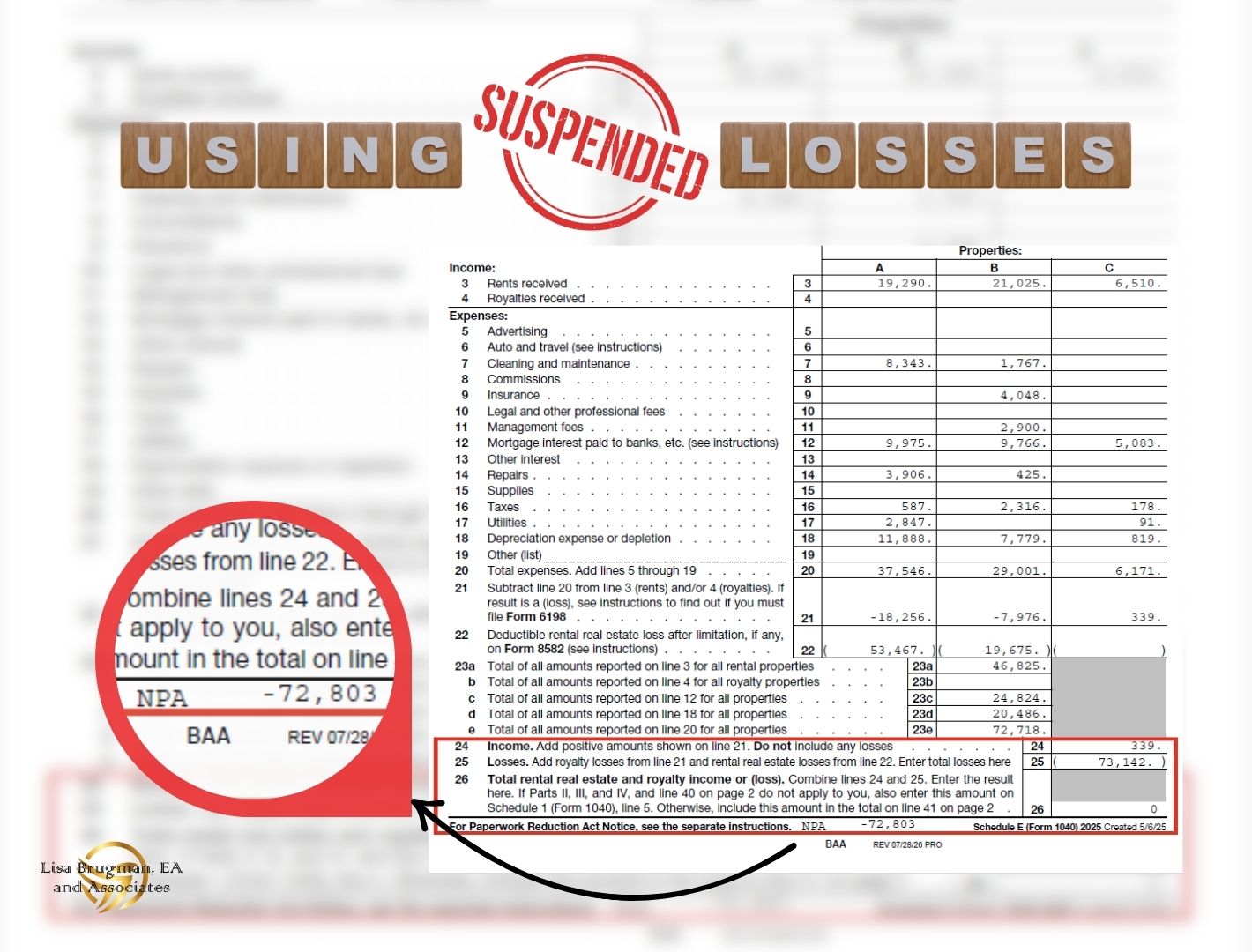
How To Use Suspended Real Estate Losses
How High-Income Real Estate Investors Can Put Suspended Losses to Work
Real estate deductions do not always create an immediate tax benefit. Sometimes the deductions are valid, but the net passive activity (NPA) rules put them in a holding pattern.
Consider a married couple with $550,000 of adjusted gross income and $158,000 of suspended Schedule E losses. Using the 2026 married-filing-jointly standard deduction of $32,200, they have approximately $517,800 of taxable income and $118,769 of regular federal income tax.
Because their income exceeds $150,000, they cannot use the special $25,000 rental loss allowance. Their $158,000 remains suspended on Form 8582 until the proper tax trigger occurs.
Here are three strategies to consider.
1. Use the Short-Term Rental Loophole
A short-term rental can create a current deduction against wages without requiring the owner to qualify as a real estate professional.
Under the passive activity regulations, an activity is not treated as a rental activity when the average customer stay is seven days or less. The owner must also materially participate for the activity to become nonpassive.
Material participation may be established by performing more than 500 hours, doing all the work substantially, or working more than 100 hours when no one else works more. Guest communication, pricing, repairs, bookkeeping, and management may count when performed as an owner. A credible time log is essential.
With only customary rental services, the activity can generally remain on Schedule E. Substantial hotel-like services can change its reporting.
Example:
Suppose the couple purchases an STR, meets the seven-day average-stay test, materially participates, and generates a $100,000 first-year loss through operating expenses, depreciation, and a properly prepared cost-segregation study.
Their simplified federal results would be:
Item Before STR After STR Loss
AGI $550,000 $450,000
Taxable income $517,800 $417,800
Regular federal
income tax $118,769 $86,609
Estimated tax savings $32,160
This new STR loss does not release the $158,000 suspended losses from unrelated long-term rentals. It is a new nonpassive loss that may offset wages, subject to basis and at-risk rules. If an existing rental becomes a qualifying STR, prior losses from that same former passive activity may offset future net income from that property.
The strategy requires the right property, real participation, documentation, and sound economics without the deduction.
2. Add Cash-Positive Passive Income
The most direct way to use suspended passive losses without creating another loss is to add eligible passive income.
Possible sources include a profitable long-term rental, a private real estate equity partnership, or a private business in which the investor does not materially participate. Improving the taxable profit of an existing passive rental can also release losses gradually.
The key is eligible passive income. Cash flow alone is insufficient. Interest, dividends, and many royalties are not passive merely because they appear on Schedule E.
Example
Assume the couple invests in a private real estate partnership that produces $80,000 of taxable passive income:
Item Amount
New passive income $80,000
Suspended loss released ($80,000)
Net taxable passive income $0
Suspended loss remaining $78,000
At the couple’s 35% marginal rate, $80,000 of additional income could otherwise produce approximately $28,000 of regular federal tax. Their suspended losses could shelter that first $80,000.
This shelters new passive income but does not reduce the original $550,000 AGI. The new income and released loss offset each other.
Before investing, review a sample K-1, activity description, projected taxable income, cash distributions, debt, fees, and restrictions. Cash distributions do not always equal taxable income.
3. Investing in Mineral Rights (with a caveat)
Mineral rights can provide cash flow and depletion deductions. The caveat: not every mineral investment produces passive income that can absorb rental losses. The result depends on what the couple owns.
Royalty interest
A royalty owner generally receives production revenue without paying drilling costs. Although commonly reported on Schedule E, royalty income is generally portfolio income for the passive activity rules. It usually cannot absorb the $158,000 rental loss.
Suppose an oil-and-gas royalty produces $60,000. If a 15% percentage-depletion deduction is available and fully allowable, the deduction would be $9,000, leaving $51,000 taxable. At a 35% marginal rate, the approximate regular federal tax would be $17,850, while the $158,000 passive loss remains suspended.
Direct working interest
A working-interest owner receives production revenue but bears drilling and operating costs. A qualifying interest held directly—or through an entity that does not limit liability—is generally nonpassive, so its income may not release the rental losses.
Private mineral or energy partnership
A private partnership or LLC that limits liability may produce passive business income when the investor does not materially participate. This version may work, but the entity structure and K-1 must support the classification.
If such an investment generates $60,000 of eligible passive income, the couple could use $60,000 of suspended losses, potentially avoiding approximately $21,000 of regular federal income tax at a 35% rate. Their remaining suspended loss would be $98,000.
Review the entity, liability provisions, sample K-1, depletion assumptions, operator history, fees, and production risks. “Reported on Schedule E” is not enough.
The Bottom Line
These strategies solve different problems. An STR may create a new nonpassive loss. A profitable passive investment may use losses already on Form 8582. A properly structured mineral investment may produce usable passive income—but royalties and direct working interests often will not.
The best strategy coordinates tax character, cash flow, documentation, and investment risk. Never let a deduction turn a poor investment into an expensive lesson.
To learn which approach fits your portfolio, book a call with Lisa Brugman, EA & Associates.


